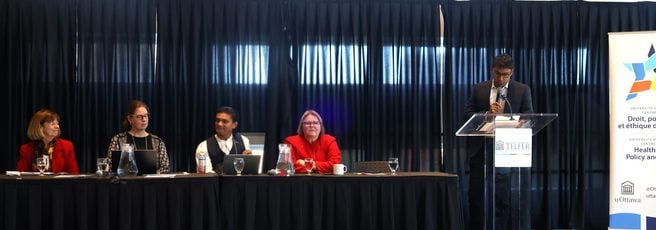
“Ottawa Charter at 40” Panel Presents on Support for Personal Skills and Social Development
As suggested in my previous post introducing the October 2026 conference in Canada that reexamined the public health goals set by the Ottawa Charter in 1986, there was reason both for modest celebration and serious critical thinking about what has happened during the last 40 years.
In a morning panel on October 21, we were tasked with the 4th Pillar of the Ottawa Charter, focusing on “personal and social development.” The presentations ranged from detailed frameworks for implementing new health measures, to my own story-telling approach about an international journey from design to implementation of a new program.
Dr. Kumanan Wilson, the CEO and Chief Scientific Officer of the Bruyère Health Research Institute in Ottawa was the Chair of our panel, guiding the talk on evidence-based changes in health policies.
Dr. Melissa Bouwers, Director of the School of Epidemiology and Public Health at the University of Ottawa led us off with multiple schematics for approaching design, implementation and demonstration of results for new measures.
Raywat Deonandan, on the Faculty of Health Sciences at University of Ottawa, brought to bear both humor and serious talk about the consequences of misinformation when identifying determinants of health.
Sophie Nunnelley, on the Faculty of Law at the University of Ottawa, had perhaps the most “au courant” task of the panel, of examining positive or negative factors associated with using direct-to-consumer AI modalities for health measures and policies.
My more modest task, was to explain how a research team, first assembled in 2009-10 to identify better systems for assisting rural or isolated older adults in obtaining information relevant to planning for health, legal or social needs, stayed the course over a 16-year timeline, from design incorporating key experiences in Denmark, to government approval(s), to the very recent “first wave” of actual implementation of our recommendations for “Preventative” or “Ageing Well” Home Support Visitors in Northern Ireland.
What I noticed is that after our remarks, all of the speakers on this panel were meeting with new potential partners who had ideas for the future. I came away with three volunteers to present their experiences to my law students in the U.S. and beyond.